Why study Physics when the world is full of big questions?
From how electricity powers our homes to how rockets travel through space, Physics helps us understand how the world works.
It also gives us the tools to solve problems, develop new technology and make sense of things we might otherwise take for granted.
When you think of Physics, you might think of equations, laboratory experiments or trying to remember Newton’s laws.
But there’s a lot more to it than that.
Physics is about understanding how things work, from the smallest particles that make up matter to the forces that shape the universe.
It helps explain why objects move, how energy is transferred, how light behaves and what happens inside stars.
And once you start looking, you’ll find Physics everywhere.
It's not just about equations
Maths is an important part of Physics, but the subject is about much more than getting the right answer. It’s about asking questions, testing ideas and using evidence to explain what happens.
Why does a car need more energy to accelerate? How does a phone turn electrical signals into sound? Why can some materials conduct electricity while others act as insulators? And what keeps planets moving around the Sun?
Physics helps you work through questions like these by looking at the forces, energy and processes involved.
You’ll learn how to apply scientific principles to real situations, make predictions and understand why the evidence supports one explanation rather than another.
Sometimes, the results might not be what you expect. Working out why is part of the challenge.
You might be surprised by how much Physics shapes everyday life
Think about how much technology you use in a typical day. Your phone, the electricity in your home, the car or bus you travel in, medical scans and the technology behind renewable energy all rely on principles of Physics.
Understanding electricity and magnetism helps engineers design electrical systems and motors. Knowledge of waves and light plays a part in communications, cameras and fibre-optic technology. Nuclear and particle physics helps scientists investigate the building blocks of matter and understand radiation.
Physics is also important as we develop ways to generate and use energy more efficiently. From improving solar panels to developing electric vehicles and designing wind turbines, physicists and engineers use scientific principles to tackle practical challenges.
So if you enjoy understanding how things work, or want to know what goes on behind the technology you use every day, Physics gives you a way to explore those questions in more depth.
You don't just learn Physics from a textbook
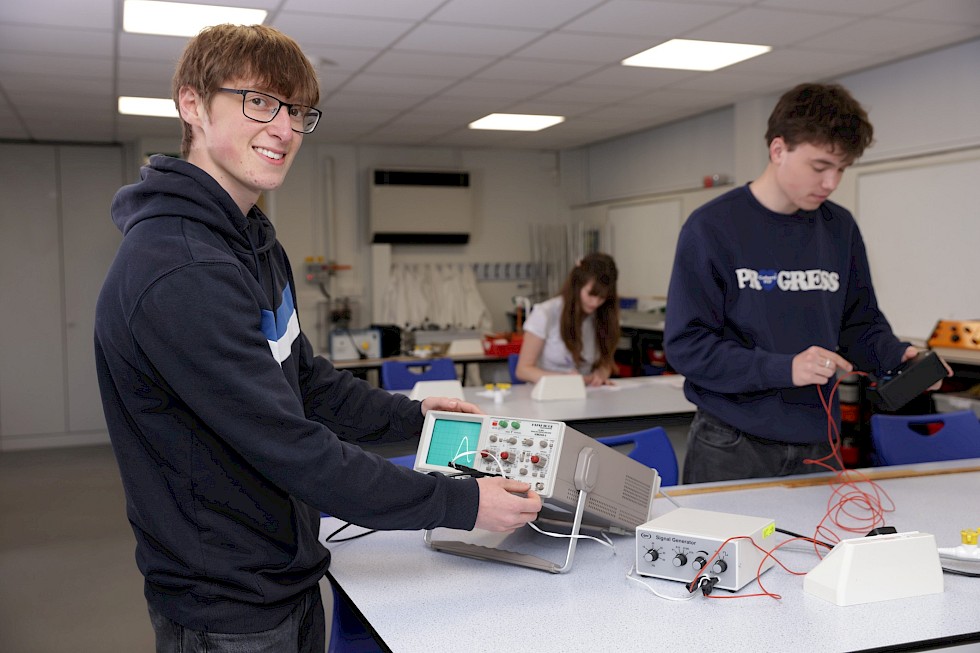
Understanding the theory is important, but Physics also involves practical work. Experiments give you the chance to investigate scientific ideas, collect measurements and see how well your results match your predictions.
You might investigate how forces affect motion, measure electrical properties in a circuit or explore how waves behave.
You'll learn to use equipment, handle data, identify patterns and think about possible sources of error. These skills help you understand not only what the results show, but also how reliable your conclusions are.
Practical work also develops your ability to solve problems when things don't go exactly as planned. You may need to repeat measurements, check your method or think about why your results differ from what you expected.
That combination of theory, maths and practical investigation is a big part of what makes Physics challenging and rewarding.
Why does Physics matter now?
Many of the challenges facing the world involve questions that Physics can help us answer. How can we generate electricity with fewer carbon emissions? How do we store energy more effectively? Can we make transport more efficient? How can medical technology help doctors diagnose and treat illness?
These questions bring together Physics, engineering and other areas of science. For example, understanding how energy is transferred and converted helps researchers and engineers improve batteries, develop renewable energy systems and reduce wasted energy. Knowledge of radiation and how it interacts with matter is important in medical imaging and cancer treatment.
Space research also relies on Physics, from understanding the movement of planets and satellites to developing the technology used in space exploration.
There isn't one subject that can solve these challenges on its own. But Physics gives you a way to understand the principles involved, assess evidence and explore possible solutions.
And as technology continues to develop, those skills will remain important.
How Physics can change your plans
Sometimes, studying a subject helps you discover a career you hadn't seriously considered before.
Former East Sussex College Physics student Harry Cooper originally chose the subject because he thought it was interesting, without planning to work in Physics. That changed during his course, when learning about magnetic fields helped him see how Physics applies to electric cars and engineering.
“There’s so many highlights in Physics, but the standout is when we covered magnetic fields and Rod described how that worked in electric cars – and as someone who’d love to be an engineer, I found that really cool! As a result I looked into engineering, it was one of those wow moments that made me want to learn more.”
Harry also developed practical skills through experiments, learning to identify errors and think creatively when solving problems. He valued the equipment available for practical work and the support he received from his tutors.
His experience shows how A-Level Physics can help you explore your interests while developing skills you can take into further study and a future career.
When Harry spoke about his plans, he was preparing to take a gap year to gain experience before studying a master’s in Engineering, with the aim of entering the industry.
So, where could Physics take you?
You don't have to become a physicist. A-Level Physics can help prepare you for a range of university courses and future careers, particularly if you're interested in science, technology, engineering or maths.
You could go on to study Physics, Astrophysics, Engineering or Mathematics at university, with well-regarded courses available at institutions such as the University of Oxford, University of Cambridge, Imperial College London, University of Warwick and University of St Andrews. Depending on your interests and further qualifications, you might explore careers in renewable energy, aerospace, electronics, medical physics, scientific research or technology.
The skills you develop can also be useful in areas that aren't immediately associated with Physics.
You'll develop skills in critical thinking, analysing information, working with data, solving problems and explaining your conclusions clearly. These skills are valuable in many technical and professional roles, but they're also important beyond the workplace. Being able to question information, think independently and work through problems for yourself helps you make informed decisions and develop your own understanding, rather than relying on technology to do the thinking for you.
As AI becomes a bigger part of everyday life, these abilities are increasingly important. The World Economic Forum has explored concerns around 'AI brain fry' and the potential effects of over-reliance on AI on our ability to think and process information.
Physics can be a useful subject to combine with Maths and other sciences if you're considering a degree in a related field. It's worth checking the entry requirements for individual university courses, as some will require particular A-Level subjects.
Could Physics be for you?
Physics could be a good choice if you're curious about how the world works and enjoy working through problems.
Perhaps you like finding out how technology works, are interested in space, or want to understand the science behind energy, transport and engineering.
You don't need to know exactly what career you want before choosing the subject. You do need to be comfortable working with maths and willing to practise applying what you learn.
A-Level Physics is a demanding course, so you'll need to keep on top of your notes, revisit difficult concepts and spend time working through problems outside lessons. If you're prepared to put in that effort, it can open up plenty of options for further study.
What could you study alongside Physics?
Physics works well alongside subjects that build on its mathematical and scientific foundations, but your best combination will depend on what you enjoy and what you might want to do next.
Interested in engineering or technology? Maths is particularly useful for developing the mathematical skills needed to study Physics in greater depth. Further Mathematics may also be worth considering if it's available to you and suits your strengths.
More interested in the wider world of science? Chemistry and Biology can complement Physics and give you a broader understanding of how the natural world works. The best combination will depend on whether you're considering a particular science degree.
Thinking about computing or data? Computer Science can be a useful partner subject if you're interested in technology, programming or using mathematical thinking to solve problems.
Interested in digital technology and data? You could also consider combining Physics with a vocational qualification such as the Digital Systems & Data V-Level. This could be a good option if you're interested in how technology works, developing digital skills and applying logical thinking to real-world challenges.
There's no single combination that works for everyone. Check the entry requirements for any university courses you're considering, and choose subjects you'll enjoy studying over two years.
Find your route
If you want to understand more about the world, enjoy solving problems and are ready to take on a subject that challenges you, A-Level Physics could be worth exploring.
You can study Physics at all of our East Sussex College campuses, building your knowledge through theory, practical work and mathematical problem-solving.
Find out more about A-Level Physics at East Sussex College: https://www.escg.ac.uk/search/?q=physics