Computing Degree Skills Help Improve Safe Staffing in Hospice Care
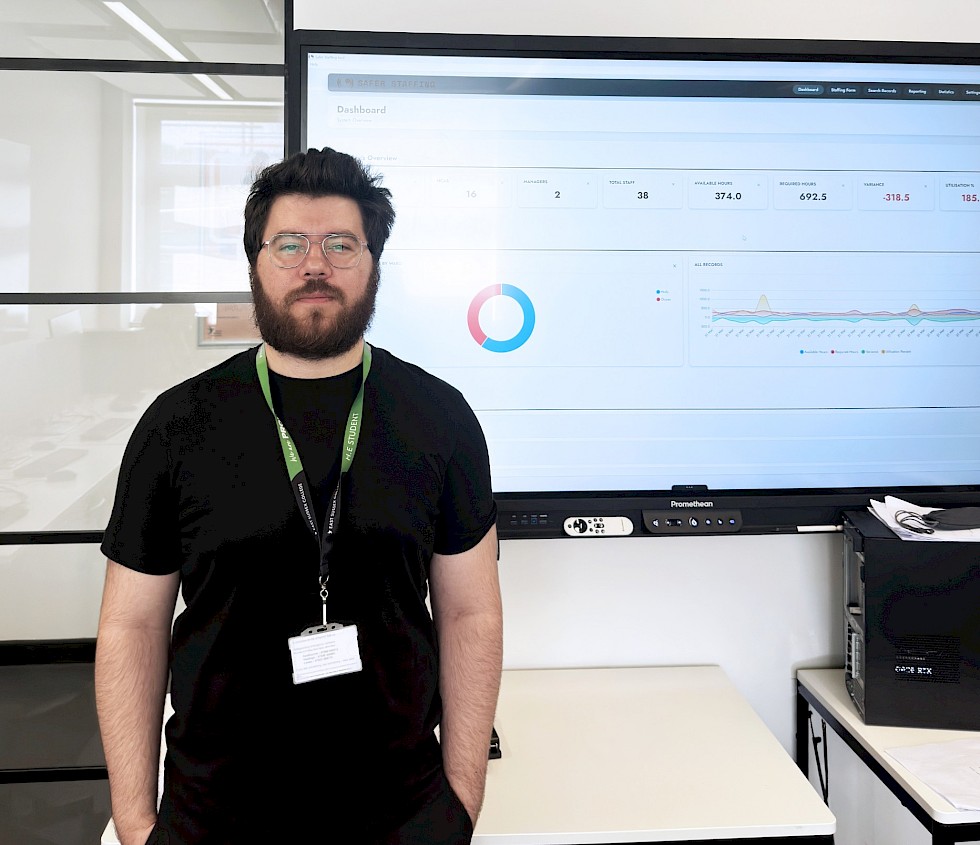
Anton Dinu-Andrei is currently completing his BSc (Hons) Computing and Systems Development top-up degree at East Sussex College while working full time as a Data and Information Officer at St Michael’s Hospice.
Alongside his studies, Anton is developing an innovative technical project focused on improving safe staffing levels in hospice environments, combining data analysis, automation and healthcare insight to support better workforce planning.
“The role itself is a hybrid of data analyst, data engineer, system admin, database administrator and so much more. Automation, you name it. I get to do everything, which means I can learn as much as possible while backing a really good cause.”
A typical day involves supporting staff requests, developing dashboards, improving systems and building automated solutions to improve efficiency.
“I’m available for anybody who needs help, and when I’m not supporting other colleagues, I’m getting my head into my project work. Whether that’s digitalising forms, creating automation, overhauling systems, or building dashboards from our data.”
Anton’s current project focuses on developing a desktop application that helps hospices make more informed staffing decisions based on patient need and workforce capacity.
“I’m building a desktop application that will allow organisations, hospices for now, to properly staff their shifts. It takes variables like patient acuity levels, staff roles and shift coverage, and produces a utilisation score.
“There’s a lot more packed in too, including prediction models and reporting tools. But you still need strategic decision making. Overreliance on data is just as bad as ignoring it - you always need that human factor.”
Anton’s project addresses a key challenge in the sector, how organisations like the hospice balance rising costs with the need to maintain high-quality care.
“Payroll costs are the biggest cost by far, almost half of the entire budget. Many hospices face pressure or even closure, so targeting the biggest cost is in my opinion the most effective approach.”
Anton uses a range of industry-standard tools and technologies in his day-to-day work, including Python, the Microsoft Azure Suite, SQL, GitHub and Power BI, helping to develop efficient and secure systems within healthcare environments. He says that his degree has helped him build both technical expertise and confidence.
“I couldn’t have done it without my degree course. I did the Level 4 and Level 5 degree at the College which gave me the knowledge and helped knock the impostor syndrome out of me, which was a big factor in helping me land the role at St Michael’s Hospice.”
“Coming back to study the top-up has been a breath of fresh air. All of my life there were overcrowded classrooms with 30+ students and all of a sudden it’s only a handful of us getting one-on-one support with amazing professors. I couldn’t say no to that.”
Anton’s journey shows how computing skills developed in the nurturing environment at East Sussex College can be applied to real-world challenges, supporting both innovation and impact in essential healthcare services.
Our degrees are designed with careers in mind, built around real-world industry needs, and delivered with flexibility in mind – often timetabled just two days per week to allow students to balance study alongside work and other commitments.